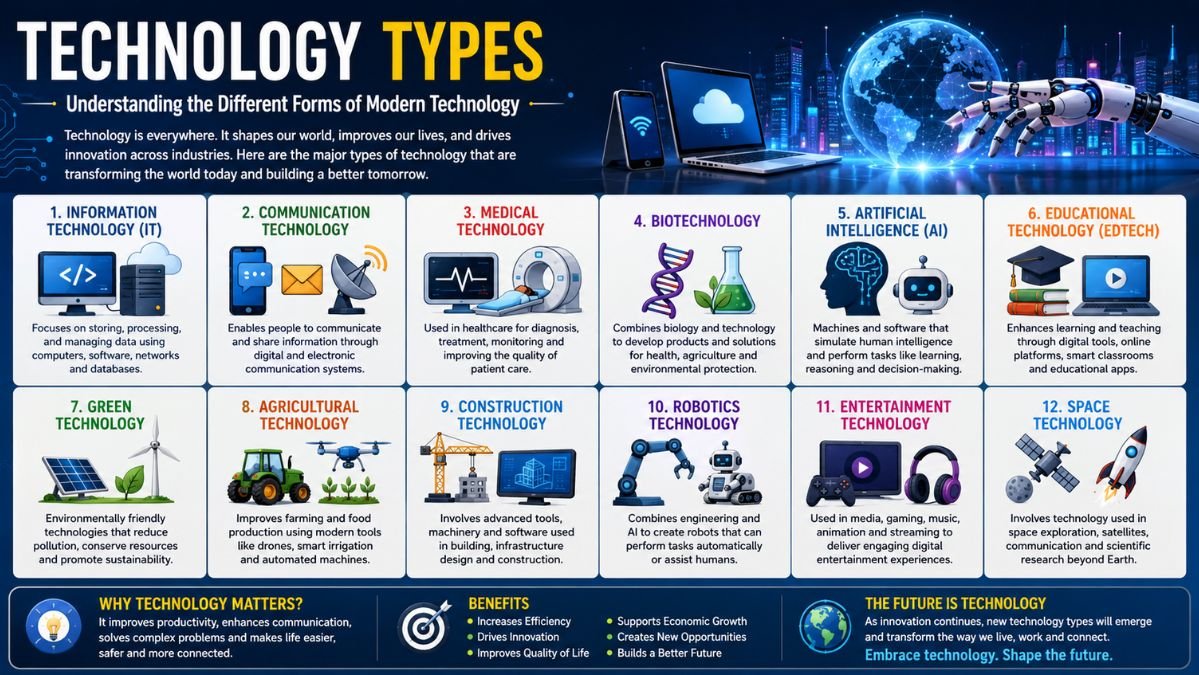
Technology has become one of the most important parts of modern human life. From smartphones and artificial intelligence to medical machines and space exploration, technology influences how people communicate, work, learn, travel, and solve problems. As the world becomes more digital and connected, understanding different technology types is essential for students, businesses, and everyday users.
Technology is not limited to computers or the internet. It includes every tool, system, machine, and scientific innovation created to improve human life and make tasks easier. Over the years, technology has evolved rapidly, creating new industries and transforming traditional ones. Today, almost every sector depends on technology for growth and efficiency.
Quick Bio Table About Technology Types
| Topic | Details |
|---|---|
| Main Keyword | Technology Types |
| Category | Technology |
| Purpose | Understanding various forms of technology |
| Major Fields | IT, AI, Medical, Communication, Robotics |
| Benefits | Efficiency, automation, connectivity, innovation |
| Modern Importance | Essential in business, education, healthcare, and daily life |
| Future Scope | AI, green tech, automation, smart systems |
What Are Technology Types?
Technology types refer to the various categories of technological systems and innovations used for different purposes. Each type focuses on solving specific problems or improving particular areas of life and industry. Some technologies improve communication, while others focus on healthcare, transportation, education, or manufacturing.
As industries evolve, technology types continue to expand, creating new opportunities and changing the way society operates.
Information Technology (IT)
Information Technology is one of the most widely used forms of technology in the modern world. It involves the use of computers, software, databases, and networks to store, process, and share information.
Businesses use IT systems for managing operations, communicating with customers, and analyzing data. Educational institutions use IT for online learning platforms, while governments use digital systems for administration and public services.
Examples of Information Technology
- Computers and laptops
- Cloud computing
- Data centers
- Software applications
- Cybersecurity systems
- Web development
Importance of IT
Information technology improves efficiency, reduces paperwork, and enables faster communication. It also supports remote work and digital business operations.
Communication Technology
Communication technology helps people exchange information quickly across different locations. Modern communication systems have made global connectivity easier than ever before.
In the past, communication relied on letters and landline phones. Today, people use smartphones, social media platforms, video calls, and instant messaging applications.
Examples
- Smartphones
- Email services
- Video conferencing apps
- Social media networks
- Wireless internet
- Satellite communication
Benefits
- Faster communication
- Global business collaboration
- Remote learning and working
- Real-time information sharing
Communication technology has transformed personal relationships, businesses, and international cooperation.
Medical Technology
Medical technology focuses on improving healthcare services, diagnosis, treatments, and patient care. Hospitals and healthcare institutions rely heavily on advanced technology to save lives and improve medical accuracy.
Modern medical equipment allows doctors to detect diseases earlier and perform complex surgeries with precision.
Examples
- MRI and CT scanners
- Robotic surgery systems
- Telemedicine platforms
- Wearable health devices
- Digital patient records
Advantages
- Improved healthcare quality
- Faster diagnosis
- Better patient monitoring
- Reduced medical errors
Medical technology became especially important during global health crises, where digital healthcare systems supported remote consultations and patient management.
Artificial Intelligence (AI)
Artificial Intelligence is one of the fastest-growing technology types today. AI allows machines and software to imitate human intelligence, learn from data, and make decisions automatically.
AI is now used in business automation, online customer support, cybersecurity, healthcare, transportation, and entertainment.
Common AI Applications
- Chatbots
- Voice assistants
- Recommendation systems
- Self-driving vehicles
- Facial recognition
- Smart home devices
Impact of AI
Artificial intelligence improves productivity and reduces manual work. However, it also raises concerns about privacy, security, and job automation.
AI is expected to become even more influential in the future as machine learning and automation continue to advance.
Biotechnology
Biotechnology combines biology with technology to create solutions for healthcare, agriculture, and environmental protection. Scientists use living organisms and biological systems to develop products and innovations.
Examples
- Genetic engineering
- Vaccine development
- Agricultural biotechnology
- Biofuels
- DNA testing
Uses of Biotechnology
- Disease treatment
- Improved crop production
- Environmental conservation
- Scientific research
Biotechnology has played a major role in medical advancements and sustainable farming practices.
Educational Technology (EdTech)
Educational technology uses digital tools to improve teaching and learning experiences. Schools, universities, and online learning platforms rely on educational technology to provide accessible and interactive education.
Examples
- Online courses
- Smart classrooms
- Educational apps
- Virtual learning platforms
- Digital libraries
Benefits
- Flexible learning
- Remote education access
- Interactive teaching methods
- Personalized learning experiences
EdTech became highly popular as online learning expanded worldwide.
Green Technology
Green technology focuses on environmentally friendly solutions designed to reduce pollution and conserve natural resources. It supports sustainability and renewable energy development.
Examples
- Solar panels
- Wind turbines
- Electric vehicles
- Recycling systems
- Energy-efficient appliances
Importance
Green technology helps reduce environmental damage and supports clean energy initiatives. Governments and businesses worldwide are investing heavily in sustainable technologies.
Agricultural Technology
Agricultural technology improves farming methods and food production systems. Modern farms use advanced equipment and digital tools to increase productivity and reduce waste.
Examples
- Smart irrigation systems
- Farming drones
- GPS-guided tractors
- Crop monitoring sensors
Advantages
- Increased crop yields
- Efficient resource management
- Reduced labor costs
- Better weather monitoring
Agricultural technology is essential for feeding growing populations and supporting food security.
Construction Technology
Construction technology involves machinery, software, and engineering systems used in building projects and infrastructure development.
Examples
- 3D architectural design software
- Heavy construction equipment
- Smart building systems
- Automated construction tools
Benefits
- Faster construction processes
- Improved worker safety
- Better project management
- Reduced material waste
Modern construction technology is helping cities develop smarter and more sustainable infrastructure.
Robotics Technology
Robotics technology focuses on designing machines that can perform tasks automatically or semi-automatically. Robots are widely used in manufacturing, healthcare, logistics, and research.
Examples
- Industrial robots
- Delivery robots
- Surgical robots
- Warehouse automation systems
Importance
Robotics improves efficiency and reduces repetitive manual labor. In industries like manufacturing, robots can operate continuously with high precision.
Entertainment Technology
Entertainment technology enhances digital media, gaming, music, and online streaming experiences. This industry has grown rapidly due to internet access and mobile devices.
Examples
- Streaming platforms
- Video game systems
- Virtual reality devices
- Animation software
Impact
Entertainment technology provides immersive experiences and supports the global media industry.
Space Technology
Space technology includes systems and equipment used for space exploration, satellite communication, and scientific research beyond Earth.
Examples
- Satellites
- Spacecraft
- GPS systems
- Space telescopes
Uses
- Navigation services
- Weather forecasting
- Space research
- Global communication
Space technology continues to advance as countries and private companies invest in space missions and satellite systems.
The Future of Technology Types
The future of technology is expected to include more automation, artificial intelligence, smart devices, and sustainable systems. Emerging technologies like quantum computing, nanotechnology, blockchain, and extended reality are likely to reshape industries over the next decade.
Businesses are adopting digital transformation strategies to stay competitive, while consumers increasingly rely on smart technologies in daily life.
Future technology trends may include:
- Fully autonomous vehicles
- Advanced AI assistants
- Smart cities
- Human-like robotics
- Renewable energy innovations
- Advanced cybersecurity systems
As technology evolves, people will need digital skills and adaptability to succeed in modern workplaces and societies.
Challenges of Modern Technology
Despite its many benefits, technology also creates challenges that society must address.
Common Challenges
- Cybersecurity threats
- Data privacy concerns
- Digital addiction
- Job displacement through automation
- Environmental impact of electronic waste
Balancing innovation with ethical responsibility will remain important in the future.
Conclusion
Technology types continue to shape the modern world in countless ways. From information technology and artificial intelligence to biotechnology and green energy systems, each category plays a unique role in improving human life and solving complex problems.
As innovation accelerates, technology will become even more integrated into education, healthcare, transportation, communication, and business operations. Understanding different technology types helps individuals and organizations prepare for the future and make informed decisions in an increasingly digital society.
For more informative articles about modern innovations, digital trends, and emerging industries, visit spheremagazines and explore the latest updates from the world of technology.