Carrier Pre Select: A Complete Guide to Telecommunications Carrier Pre-Selection

In the telecommunications industry, businesses and consumers are always looking for ways to reduce communication costs while maintaining reliable service. One solution that gained popularity during the era of fixed-line telecommunications is Carrier Pre Select (CPS). Although modern technologies such as VoIP and mobile networks have changed the telecommunications landscape, Carrier Pre Select remains an important concept in telecom history and network management.
This article explores what Carrier Pre Select is, how it works, its benefits, challenges, and its relevance in today’s communications environment.
Quick Bio Table
| Feature | Details |
|---|---|
| Term | Carrier Pre Select (CPS) |
| Industry | Telecommunications |
| Purpose | Automatic selection of a preferred phone carrier |
| Introduced | During telecom deregulation era |
| Main Benefit | Reduced call costs and improved competition |
| Used By | Businesses and residential customers |
| Technology Type | Fixed-line telecommunications service |
| Alternative Name | Carrier Pre-Selection |
| Current Relevance | Limited but still used in some telecom markets |
What Is Carrier Pre Select?
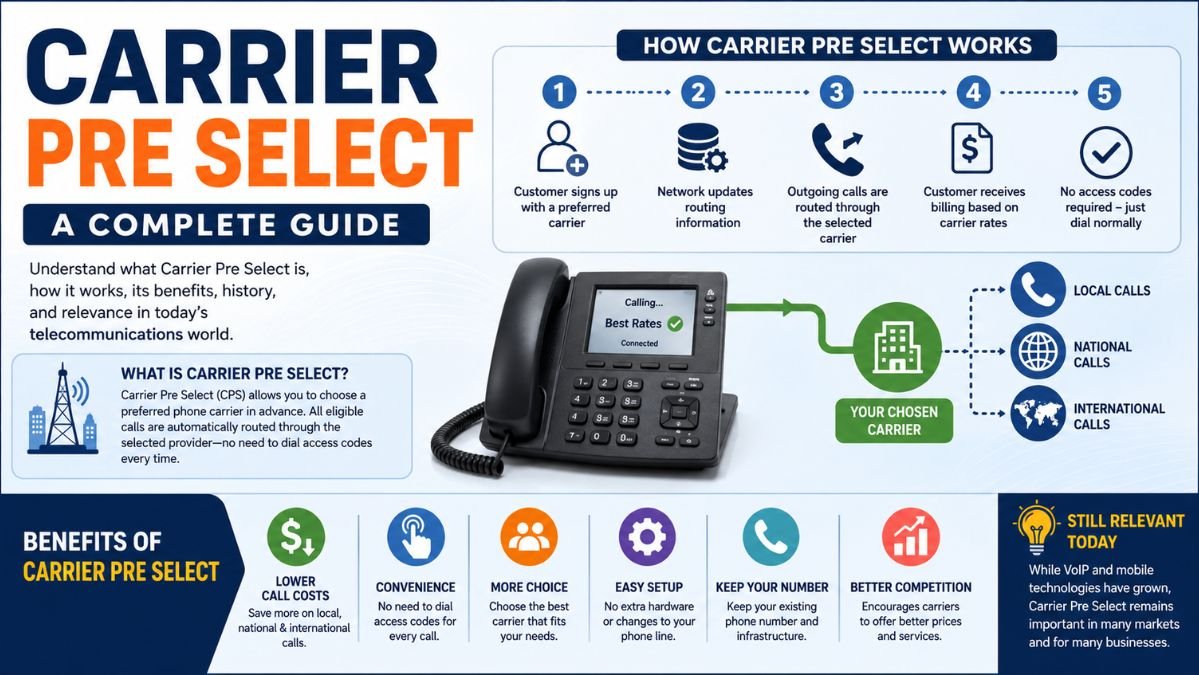
Carrier Pre Select, often abbreviated as CPS, is a telecommunications service that allows a customer to choose a preferred carrier for outgoing calls. Once the service is activated, all eligible calls are automatically routed through the selected telecommunications provider without requiring the user to dial a special access code.
Before Carrier Pre Select became available, customers often had to enter specific prefixes before making calls through alternative providers. CPS eliminated this extra step by automatically directing calls through the chosen carrier.
The concept was introduced as part of telecommunications deregulation efforts aimed at increasing competition among service providers and offering consumers more choices.
How Carrier Pre Select Works
The process behind Carrier Pre Select is relatively straightforward. A customer continues to use their existing telephone line while selecting an alternative carrier for handling outgoing calls.
The typical process includes:
- The customer signs up with a preferred telecommunications provider.
- The network operator updates routing information.
- Outgoing calls are automatically sent through the selected carrier.
- The customer receives billing according to the chosen carrier’s pricing structure.
- No special dialing codes are required.
This automatic routing mechanism simplifies communication while allowing customers to benefit from competitive pricing.
The History of Carrier Pre Select
Carrier Pre Select emerged during a period when many countries began opening their telecommunications markets to competition. Prior to deregulation, national telecommunications companies often held monopolies over telephone services.
Governments and regulatory authorities introduced CPS to encourage competition. By allowing consumers to choose different carriers while retaining their existing phone lines, telecommunications markets became more competitive.
Countries across Europe, including Germany, the United Kingdom, and the Netherlands, widely adopted Carrier Pre Select programs. These initiatives led to lower call prices and improved customer service as providers competed for subscribers.
Why Carrier Pre Select Became Popular
Several factors contributed to the popularity of Carrier Pre Select.
Cost Savings
One of the primary reasons customers adopted CPS was the potential for lower calling costs. Alternative carriers often offered more attractive rates for local, national, and international calls.
Businesses with significant call volumes especially benefited from reduced telecommunications expenses.
Convenience
Carrier Pre Select eliminated the need to remember and dial carrier-specific prefixes before every call. Users simply picked up the phone and dialed normally while the system handled carrier selection automatically.
Increased Competition
The introduction of CPS encouraged telecommunications providers to improve services and lower prices. This competition created a more consumer-friendly market.
Flexibility
Customers could switch providers without changing their telephone numbers or physical infrastructure. This flexibility made the transition process simple and attractive.
Benefits of Carrier Pre Select
Reduced Communication Costs
Businesses and households often experienced significant savings by choosing carriers that specialized in affordable calling rates.
Easy Implementation
Since CPS works through network configuration rather than hardware changes, implementation is relatively simple.
No Equipment Upgrades
Customers generally do not need new phones, routers, or communication systems to use Carrier Pre Select.
Better Service Options
Competition among providers encourages innovation and customer-focused service offerings.
Number Retention
Users can keep their existing telephone numbers while taking advantage of alternative carriers.
Carrier Select vs Carrier Pre Select
Many people confuse Carrier Select with Carrier Pre Select. While both involve choosing a telecommunications provider, there are important differences.
Carrier Select
With Carrier Select, the user manually chooses a carrier for each call by entering a carrier access code or prefix.
Carrier Pre Select
With Carrier Pre Select, the carrier is chosen in advance and all eligible calls are automatically routed through that provider.
As a result, Carrier Pre Select offers greater convenience and automation.
Carrier Pre Select for Businesses
Businesses were among the biggest beneficiaries of CPS programs.
Organizations with multiple phone lines and high call volumes could negotiate favorable rates with alternative carriers while maintaining their existing infrastructure.
Benefits for businesses included:
- Lower operating costs
- Predictable billing
- Improved budget management
- Flexible carrier options
- Enhanced telecommunications efficiency
Large enterprises often combined Carrier Pre Select with Least Cost Routing strategies to maximize savings.
Challenges and Limitations
Despite its advantages, Carrier Pre Select also has several limitations.
Decline of Fixed-Line Telephony
The growth of mobile phones has significantly reduced demand for traditional fixed-line services.
Rise of VoIP Technology
Voice over Internet Protocol (VoIP) solutions provide low-cost calling options that often eliminate the need for Carrier Pre Select arrangements.
Unlimited Calling Plans
Many modern telecommunications packages include unlimited local and international calling, reducing the importance of carrier selection.
Market Changes
As telecommunications networks evolve toward IP-based infrastructures, traditional CPS systems become less relevant.
Carrier Pre Select in the Modern Era
Although CPS remains available in certain markets, its role has diminished compared to previous decades.
Today’s telecommunications landscape is dominated by:
- Mobile communication services
- Internet-based calling platforms
- Cloud communication systems
- Unified communications solutions
- VoIP providers
However, understanding Carrier Pre Select remains valuable because it played a significant role in shaping modern telecommunications competition and regulatory frameworks.
Many of the principles introduced through CPS programs continue to influence how telecommunications markets operate today.
Future Outlook
The future of Carrier Pre Select is closely linked to the continued evolution of telecommunications technology.
While traditional fixed-line CPS services may continue to decline, the underlying concept of allowing customers to choose communication providers remains highly relevant.
Future communication systems are likely to focus on:
- Greater consumer choice
- Cloud-based communications
- Software-defined networking
- Intelligent call routing
- Advanced telecommunications management
As technology evolves, the spirit of Carrier Pre Select—providing flexibility and competition—will continue to influence the industry.
Conclusion
Carrier Pre Select was a groundbreaking telecommunications innovation that gave consumers and businesses greater control over their communication costs. By allowing users to pre-select a preferred carrier, CPS simplified calling processes, encouraged market competition, and reduced telephone expenses.
Although modern communication technologies such as mobile networks and VoIP services have reduced its prominence, Carrier Pre Select remains an important chapter in telecommunications history. Understanding how CPS works provides valuable insight into the evolution of competitive telecom markets and customer-focused service models.