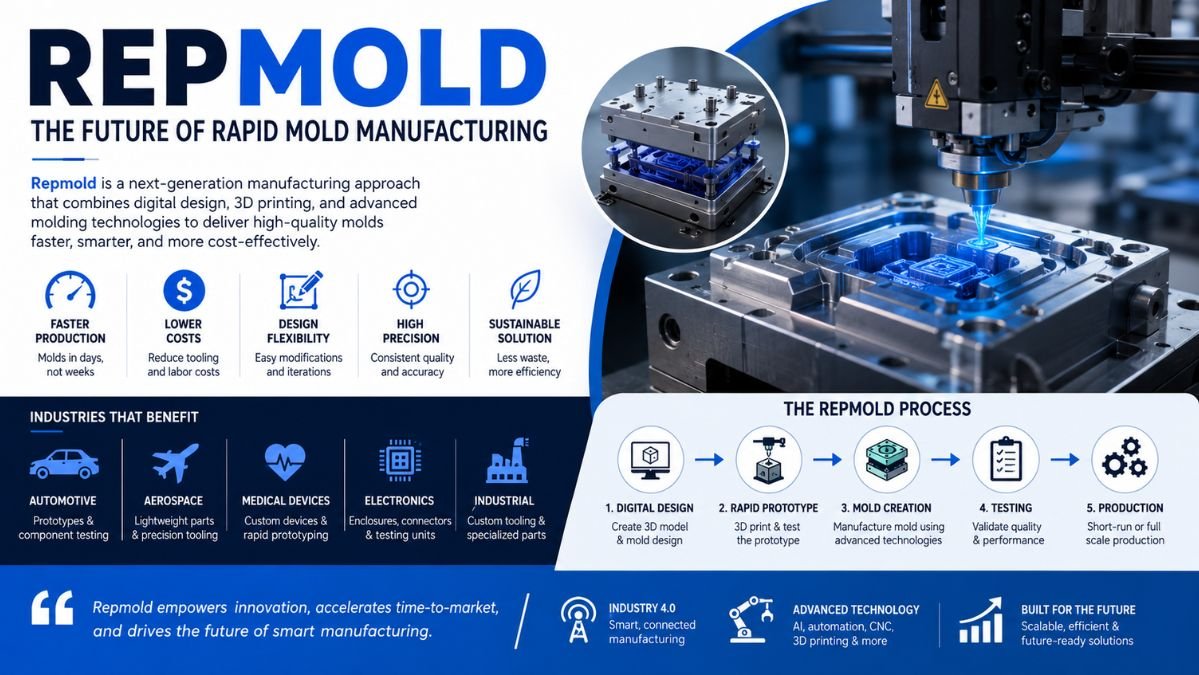
In today’s fast-paced manufacturing world, businesses are constantly searching for ways to reduce costs, speed up production, and improve product quality. One emerging concept gaining attention in industrial and manufacturing circles is Repmold. While still relatively new compared to traditional mold-making techniques, Repmold represents a modern approach that combines rapid prototyping, digital manufacturing, and advanced tooling technologies to create molds faster and more efficiently.
As industries continue to embrace automation and Industry 4.0 principles, Repmold has become an important topic for manufacturers looking to stay competitive. This article explores what Repmold is, how it works, its benefits, applications, challenges, and why it may play a significant role in the future of manufacturing.
Quick Bio Table
| Topic | Details |
|---|---|
| Name | Repmold |
| Type | Manufacturing Technology Concept |
| Industry | Manufacturing & Industrial Engineering |
| Main Purpose | Rapid Mold Creation and Prototyping |
| Key Technologies | CAD, CNC Machining, 3D Printing |
| Major Benefit | Faster Production Cycles |
| Common Applications | Automotive, Aerospace, Medical Devices |
| Production Style | Low to Medium Volume Manufacturing |
| Focus Area | Cost Reduction and Efficiency |
| Future Relevance | Industry 4.0 and Smart Manufacturing |
What Is Repmold?
Repmold is generally described as a manufacturing methodology focused on creating molds quickly and efficiently through the use of digital technologies. The term is often associated with replication molding, rapid molding, and advanced prototyping systems that help businesses move from concept to production in significantly less time than traditional methods.
Unlike conventional mold manufacturing, which often requires expensive steel tooling and lengthy production timelines, Repmold emphasizes speed, flexibility, and digital integration. Manufacturers can design, test, modify, and produce molds in a fraction of the time required by traditional processes.
The concept is especially valuable for companies developing new products, testing prototypes, or producing limited manufacturing runs before committing to large-scale production.
How Repmold Works
The Repmold process typically begins with digital product design. Engineers use Computer-Aided Design (CAD) software to create detailed product models and mold specifications.
The process generally follows these steps:
1. Digital Design
Engineers create detailed 3D models of the product and mold using advanced design software. This digital-first approach allows for easy modifications and rapid adjustments.
2. Prototype Development
Once the design is complete, a prototype can be produced using additive manufacturing technologies such as 3D printing. This stage helps identify design flaws before production begins.
3. Mold Fabrication
The mold is manufactured using technologies such as:
- CNC machining
- 3D printing
- Composite tooling
- Epoxy mold systems
- Hybrid manufacturing methods
4. Product Testing
Manufacturers test the mold and final product to ensure quality, accuracy, and performance standards are met.
5. Production Launch
After successful testing, the mold is used for short-run production, bridge tooling, or commercial manufacturing.
Key Technologies Behind Repmold
Several advanced technologies contribute to the success of Repmold systems.
Computer-Aided Design (CAD)
CAD software serves as the foundation of modern mold design. Engineers can create highly accurate models while reducing human errors and design inconsistencies.
Additive Manufacturing
3D printing enables rapid creation of prototypes and mold components. This technology significantly reduces lead times and allows manufacturers to test designs quickly.
CNC Machining
Computer Numerical Control machining delivers precise mold components with excellent surface finishes and dimensional accuracy.
Smart Manufacturing Systems
Many Repmold workflows incorporate automation, sensors, and real-time monitoring systems to optimize production efficiency.
Artificial Intelligence
AI-assisted design and production planning help manufacturers predict performance issues and improve overall manufacturing outcomes.
Benefits of Repmold
Faster Time-to-Market
One of the most significant advantages of Repmold is speed. Traditional mold creation may take weeks or months, while modern rapid molding approaches can reduce production timelines dramatically.
Reduced Manufacturing Costs
Repmold helps minimize expenses associated with:
- Tooling
- Material waste
- Labor costs
- Design revisions
This makes it particularly attractive for startups and small manufacturers.
Greater Design Flexibility
Because designs exist in a digital environment, modifications can be implemented quickly without requiring expensive tooling changes.
Improved Product Development
Rapid prototyping allows businesses to test multiple design variations before entering full-scale production.
Sustainable Manufacturing
Modern molding approaches often reduce waste materials and improve resource utilization, supporting environmental sustainability goals.
Industries That Use Repmold
Automotive Industry
Automotive manufacturers frequently require prototypes and limited production runs for testing and development. Repmold enables rapid validation of new vehicle components before mass production.
Aerospace Industry
Aerospace companies rely on precision and accuracy. Repmold helps create lightweight components and highly detailed tooling systems for specialized applications.
Medical Device Manufacturing
Medical equipment manufacturers benefit from rapid development cycles and custom production capabilities. Repmold supports innovation while maintaining strict quality standards.
Consumer Electronics
The electronics industry depends on quick product launches and constant innovation. Repmold helps companies develop housings, connectors, and other components efficiently.
Industrial Equipment Manufacturing
Factories and industrial businesses often require custom tooling and replacement parts. Repmold offers an efficient solution for specialized manufacturing needs.
Repmold vs Traditional Mold Manufacturing
Traditional mold-making methods remain effective for large-scale production, but they often involve significant costs and long lead times.
Repmold offers several advantages:
- Faster mold creation
- Lower development costs
- Easier design revisions
- Improved flexibility
- Reduced waste
However, traditional steel molds may still be preferable for extremely high-volume production environments where durability is critical.
Challenges and Limitations
Despite its advantages, Repmold is not without challenges.
Limited Lifespan of Some Molds
Certain rapid tooling materials may not last as long as hardened steel molds used in traditional manufacturing.
Initial Technology Investment
Companies may need to invest in:
- Advanced software
- Specialized equipment
- Employee training
Integration Challenges
Organizations using older manufacturing systems may face difficulties integrating modern digital workflows.
Material Restrictions
Not all materials are suitable for every rapid molding process, which can limit certain applications.
The Future of Repmold
As manufacturing technology continues to evolve, Repmold is expected to become increasingly important. Industry experts predict greater adoption of:
- AI-driven design systems
- Digital twins
- Smart factories
- Advanced automation
- Sustainable manufacturing practices
The growing demand for customized products and shorter production cycles will likely accelerate the use of rapid molding solutions worldwide.
Businesses that embrace these technologies early may gain competitive advantages through improved efficiency, reduced costs, and faster innovation cycles.
Why Repmold Matters Today
Modern consumers expect innovation at a faster pace than ever before. Manufacturers must adapt by reducing development timelines while maintaining high quality standards. Repmold addresses these demands by combining digital design, advanced manufacturing technologies, and flexible production methods.
Its ability to streamline product development, reduce costs, and support innovation makes it a valuable solution for organizations across multiple industries. As smart manufacturing continues to expand, Repmold is positioned to play a major role in shaping the future of industrial production.